
Shipping electronics isn’t like shipping t-shirts, and the best 3PL companies for tech brands know that difference well. Fragile components, serialized inventory, platform connections, and customers who expect next-day delivery make this category genuinely demanding. After reviewing dozens of providers across warehouse footprint, platform compatibility, and real-world order accuracy, the gap between a good fit and a poor one becomes clear fast. This guide covers five standout providers that actually understand what electronics fulfillment requires.
The vetting process for this list
Every provider on this list was assessed through publicly available sources, including case studies, user reviews, feature documentation, and official company websites. Only companies with a demonstrated track record in logistics made the cut.
→ See the full research breakdown
- Rush Order – Best for e-commerce fulfillment and retail logistics
- Speed Commerce – Best for e-commerce order fulfillment and logistics
- Fidelitone – Best for enterprise supply chain and logistics operations
- Fulfyld – Best for e-commerce fulfillment and third-party logistics
- Red Stag Fulfillment – Best for big, heavy, bulky product fulfillment and DTC e-commerce
The Difference the Right 3PL Companies Make
Picking a 3PL without thinking through warehouse proximity is one of the most expensive mistakes a tech brand can make. Last-mile shipping costs pile up fast when your fulfillment center sits three zones away from your core customer base.
Platform fit matters just as much. If a 3PL can’t sync cleanly with Shopify, Amazon, or WooCommerce, you’re looking at manual reconciliation and inventory drift that causes stockouts at the worst possible moments.
The right partner closes both gaps. They place inventory closer to demand, connect directly to your sales channels, and give you real-time visibility into what’s moving and what’s sitting.
That combination directly affects your order accuracy rate, your on-time shipping rate, and what you’re actually paying per order fulfilled. Those are the numbers where the right 3PL choice shows up in a meaningful way.
The 5 Best 3PL Companies: Quick Comparison
Information presented in this table draws from customer feedback channels and each organization’s publicly available company details.
| Company Name | Years Operating | Team Size | Headquartered In |
| Rush Order | Est. 1989 | 201-500 employees | Gilroy, CA |
| Speed Commerce | Est. 1983 | 1,609 employees | Las Vegas, NV |
| Fidelitone | Est. 1929 | 501-1,000 employees | Wauconda, IL |
| Fulfyld | Est. 2016 | Not disclosed | Huntsville, AL |
| Red Stag Fulfillment | Est. 2013 | 185 employees | Knoxville, TN |
Rush Order – Best for E-Commerce Fulfillment and Retail Logistics
Which Services Does Rush Order Provide?
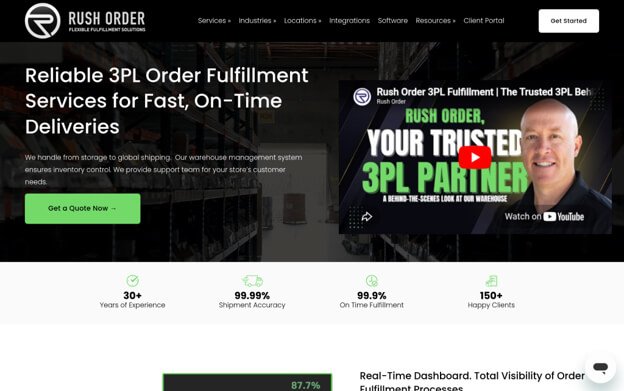
Rush Order has been running fulfillment operations since 1989, which means they’ve seen every version of what e-commerce demands from a logistics partner. They provide their consumer electronics fulfillment services across 13 locations spanning North America, Europe, Asia, and Australia. Pick-and-pack, kitting, custom packaging, inventory management, and retailer EDI are all part of their standard offering. Their warehouse management system connects directly with Shopify, Amazon, and NetSuite, so inventory stays accurate across every channel without manual intervention.
What’s Rush Order’s Edge in 3PL Companies?
The real differentiator is their multi-checkpoint barcode verification system, which removes human error from the equation before an order ever leaves the dock. For tech brands where a wrong SKU shipped means a damaged customer relationship, that kind of accuracy is rare and hard to match.
From the User Reviews:
Clients consistently point to how well Rush Order handles scaling without putting internal strain on their team. The same-day shipping capability for pre-2pm orders comes up often as a practical win. The pattern in client feedback suggests that reliability is their most consistent strength.
Speed Commerce – Best for E-Commerce Order Fulfillment and Logistics
Which Services Does Speed Commerce Provide?
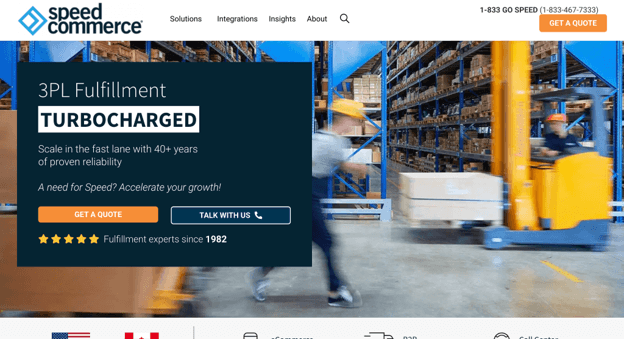
Speed Commerce covers a wide range of fulfillment needs, from web platform development and order management to full logistics and contact center support. Founded in 1983 and staffed by over 1,600 people, they bring serious operational depth to the table. Their fulfillment centers use unit sortation and radio frequency scanning, and they run 24/7/365 with returns management built in. What sets them apart is that they own and maintain their own software platforms rather than relying on third-party tools.
What’s Speed Commerce’s Edge in 3PL Companies?
Speed Commerce solves the problem of rigid, one-size-fits-all fulfillment by building software in-house, which means their systems can actually flex around a client’s specific workflow. That kind of platform ownership translates into fewer workarounds and cleaner data across the supply chain.
From the User Reviews:
Publicly documented reviews for Speed Commerce are limited, which makes it harder to draw strong conclusions from user sentiment. What the data does show is that their mix of scale and custom software ownership positions them well for mid-to-large retailers. And honestly, 40-plus years in the field carries its own credibility.
Fidelitone – Best for Enterprise Supply Chain and Logistics Operations
Which Services Does Fidelitone Provide?
Fidelitone has been operating since 1929, and its service range reflects that depth. They cover inbound logistics, order fulfillment, last-mile delivery, and service parts management across 64 locations. Their Partner Portal gives clients real-time visibility into inventory, orders, and analytics, which is a meaningful advantage for operations managing complex product catalogs. They serve manufacturers across consumer electronics, home improvement, power tools, and furniture, so they’re not new to high-value, fragile product categories.
What’s Fidelitone’s Edge in 3PL Companies?
Fidelitone addresses the challenge of maintaining fill rates and first-time repair performance at scale, areas where many providers fall short under volume pressure. Their fill rates consistently land in the 95-99% range, and their first-time repair rates exceed 90%, which tells you their tracking systems are working.
From the User Reviews:
Fidelitone was named the 2019 Home Delivery Carrier of the Year by DHL and has appeared on MCM’s Top 3PL list for both 2021 and 2022. That kind of industry recognition builds trust that’s hard to manufacture through marketing alone. Their reputation, from what the data shows, is built on consistent performance rather than one-time wins.
Fulfyld – Best for E-Commerce Fulfillment and Third-Party Logistics
Which Services Does Fulfyld Provide?
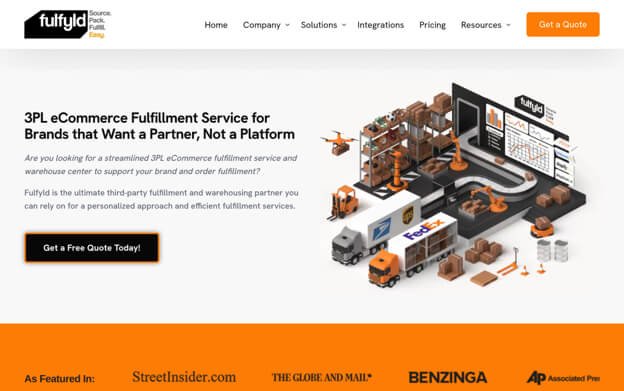
Fulfyld focuses exclusively on e-commerce fulfillment, and that focus shows in how they’ve built their operation. Based in Huntsville, Alabama, they run a 130,000 sq ft warehouse with InVia Robotics automation for picking accuracy. They connect with over 100 shopping carts and marketplaces, offer same-day shipping, and price on a flat-rate model with volume discounts. There are no minimum order requirements, which makes them accessible to brands at earlier growth stages (not cheap per unit, but fair for what you get).
What’s Fulfyld’s Edge in 3PL Companies?
Fulfyld solves the common problem of growing brands getting deprioritized by larger 3PLs through dedicated account management for every client. That personal attention makes a real difference when you need a fast answer during a peak shipping period.
From the User Reviews:
Client feedback points to positive delivery outcomes and increased fulfillment capacity, particularly for brands in adjacent physical product categories. Publicly available reviews are limited given how recently the company was founded. Their robotics investment and no-minimum-order model suggest they’re building for the long term, not just easy wins.
Red Stag Fulfillment – Best for Big, Heavy, Bulky Product Fulfillment and DTC E-Commerce
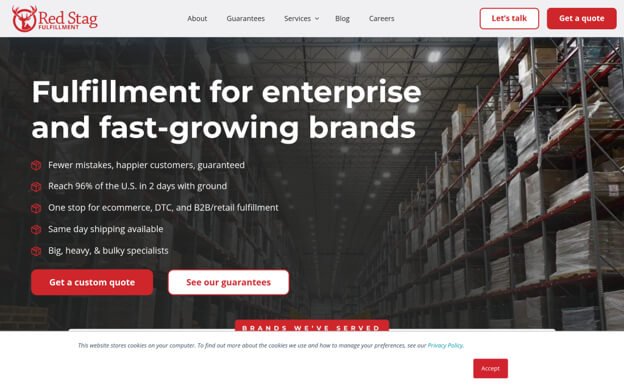
Which Services Does Red Stag Fulfillment Provide?
Red Stag Fulfillment operates 1.2 million square feet of warehouse space across two locations and focuses on products that most 3PLs find inconvenient: heavy, bulky items over 20 pounds, and high-velocity lightweight goods. They handle DTC, retail, and e-commerce fulfillment with connections to Amazon, Shopify, and custom APIs. What genuinely stands out is their performance guarantee structure, where they pay clients when they miss a commitment. That’s a bold position, and one that reflects real confidence in their operations.
What’s Red Stag Fulfillment’s Edge in 3PL Companies?
Red Stag tackles the problem of unpredictable service quality head-on by backing their promises with financial accountability, something almost no other 3PL in this category does. Their founder-owned, selective-client model means they’re not sacrificing service quality for fast growth.
From the User Reviews:
Red Stag has earned a 98% overall rating on WebRetailer and has been named one of the best 3PLs for small businesses by Fit Small Business for six straight years (that kind of streak is hard to fake). Customer feedback consistently points to communication quality and operational dependability. The performance-guarantee model isn’t just marketing (it shows up in how their team operates day-to-day).
The Process Behind This Ranking
Building a reliable shortlist of logistics providers takes more than skimming company websites. The research behind this ranking involved pulling from multiple source types to get a full picture of how each provider actually performs.
Starting With Information Assembly
The process began by scanning logistics directories, third-party review platforms, and industry publications to build a broad longlist of active 3PL providers. Each source was treated as a starting point rather than a final answer. Case studies were gathered where available, and company positioning was noted to identify which providers made claims specific to electronics, high-value goods, or e-commerce scale.
Pre-Verification Phase
Once the longlist was assembled, providers with thin public records were removed. Review patterns were analyzed across multiple platforms to identify consistent feedback versus one-off outliers. Providers whose documentation was outdated, inconsistent, or unverifiable were set aside at this stage. The goal was to carry forward only companies with enough of a public footprint to assess honestly.
The Verification Phase
Each remaining company’s website claims were cross-referenced against what appeared in independent reviews, press mentions, and available case study outcomes. Where a company claimed specific performance benchmarks, like fill rates or shipping speed, those claims were tested against what actual clients reported. Discrepancies between marketing copy and documented outcomes were flagged and factored into the assessment.
Tracking Authority Markers
Industry awards, trade publication mentions, and original research published by or about each provider were collected and weighed. Recognition from organizations with established credibility in logistics (like DHL’s carrier designations or Multichannel Merchant’s annual rankings) was treated as a meaningful signal. Providers with repeated, year-over-year recognition were viewed as more consistent than those with single-year appearances.
3PL Companies Proof Points
Finally, each company’s depth in the logistics space was assessed through the presence of dedicated service pages for relevant categories, verified client reviews that reference specific product types or operational scenarios, and documented case studies with measurable outcomes. Providers that could show hands-on experience with electronics, fragile goods, high-SKU catalogs, or platform connections received stronger consideration. The final five represent the providers that held up across every stage of this process.
How to Pick Your Best Match
Choosing the right 3PL for an electronics or tech brand comes down to more than price per order. The providers on this list each serve a different type of operation, and matching your actual needs to their actual strengths is the only way this decision pays off.
- Industry/Domain Experience: Look for providers with documented experience handling electronics or high-value physical goods. General fulfillment experience is useful, but familiarity with serialized inventory, fragile packaging, and tech retail timelines is a different skill set entirely.
- Features and Services: Confirm that the provider supports the specific services your operation needs, whether that’s kitting, returns processing, retailer EDI, or last-mile delivery. A long feature list means nothing if the services you need are add-ons with unclear terms.
- Pricing Structure: Flat-rate models work well for predictable volume, but variable pricing can be better for brands with seasonal spikes. Ask for a full breakdown of storage, handling, and shipping fees before committing.
- Results Measurement: Any credible 3PL should be able to share data on order accuracy rate, on-time shipping rate, and order cycle time. If a provider can’t give you those numbers, that’s worth taking seriously.
- Industry Knowledge and Compliance: Tech brands often deal with DOT, FDA, customs, and hazmat regulations depending on the product category. Make sure your 3PL has experience working through those requirements, not just a checkbox that says they do.
Closing Thoughts
The right 3PL for a tech brand isn’t the biggest name or the cheapest rate. It’s the provider whose warehouse footprint, platform connections, and handling knowledge actually match what your products and customers require. The five companies covered here each bring something distinct, from long operational history to robotics-backed accuracy to performance guarantees. As e-commerce fulfillment keeps getting more competitive, choosing a partner with real logistics depth will continue to matter more, not less.