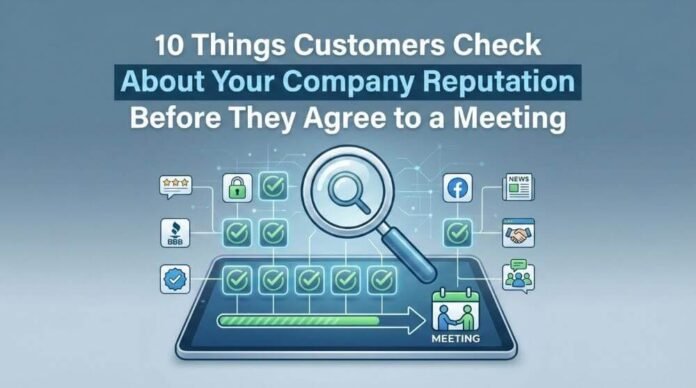
Gartner research puts it plainly: 87 percent of buyers research a company’s reputation before agreeing to a first meeting. That research happens before you ever get on the phone with them, before you send a proposal, and often before they reach out at all. What they find determines whether the conversation happens.
Here is what they are actually looking at.
1. Online Reviews and Star Ratings
Google, Yelp, Trustpilot, and industry-specific platforms are the first stop for most buyers. They are not reading every review. They are scanning for patterns. A cluster of one-star reviews mentioning the same issue, slow response times, poor communication, and billing problems, is a pattern. One or two negative reviews among dozens of positives is not.
What matters as much as the rating itself is how the company responds to criticism. An owner’s response that acknowledges an issue and explains what changed signals accountability. No response, or a defensive one, signals the opposite.
Keep an eye on your six-month review trend, not just your overall score. A rating that was 4.4 a year ago and is now 4.1 tells a different story than a stable 4.1.
2. Your Website, and How Fast It Loads
First impressions form in roughly 50 milliseconds. A slow, cluttered, or outdated website not only frustrates visitors but also undermines the credibility of the website and its owner. It signals that the company does not pay attention to detail or invest in its own presentation.
Buyers check load speed, mobile responsiveness, and basic trust signals. The benchmarks that matter:
- PageSpeed score above 90 on both desktop and mobile
- Load time under three seconds
- Valid SSL certificate with HTTPS across all pages
- Passing Core Web Vitals
Red flags are easy to spot: stock photos standing in for real team images, broken links, no contact page, or a site that renders poorly on a phone. These details communicate something about how the company operates before a single word is read.
Clean navigation, real photography, and a straightforward About page with actual team information carry more weight than most companies realize.
3. Social Media Presence and Engagement
Prospects scroll through your LinkedIn and, sometimes, your Twitter, Facebook, and Instagram before a meeting. They are not looking for follower counts. They are looking for signs of life: consistent posting, genuine engagement, responses to comments, evidence that a real team operates the account.
The engagement rate matters more than raw follower numbers. A company with 10,000 followers and 0.1 percent engagement has an audience that does not respond to any of its posts. Buyers notice that. A company with 2,000 followers and steady interaction looks more credible.
| Platform | Healthy Engagement Rate | Red Flags |
| 2% or higher | Stale posts, no comments or replies | |
| Twitter/X | 1.5% or higher | Bot replies, no original content |
| 3% or higher | Inactive page, unanswered comments | |
| 4% or higher | Bought likes, no stories or reels |
Sudden follower spikes without matching engagement are visible with free tools like SocialBlade. Buyers who check will see it.
4. Leadership and Team Profiles
C-suite LinkedIn profiles get checked. Buyers want to see real professional history, a clearly listed current role, a reasonable number of connections, and some evidence of engagement with the industry. A CEO profile with 47 connections, no activity, and a job title that does not match the company website raises questions.
Beyond the CEO, the team page on your website matters. Real photos, actual bios, and some indication of relevant experience build confidence. Generic headshots and vague descriptions do the opposite.
Other signals buyers verify: Crunchbase profiles, speaker appearances at industry events, guest posts or bylines in credible publications, and podcast appearances. These are not mandatory, but their presence builds a picture of a company with genuine standing in its field.
5. Client Testimonials and Case Studies
Testimonials that name specific clients and include measurable outcomes carry weight. A statement like “reduced customer churn by 47 percent for Acme Corp in Q3 2023” is verifiable and specific. “Great company to work with, highly recommend,” attributed to “J.D. in Florida,” is not.
Buyers cross-reference. They check whether the named client actually exists, whether the logo on your website matches a real company, and whether the outcome claimed aligns with what the company does. This takes about two minutes on LinkedIn.
Case studies should be dated. A case study from 2019 does not tell a prospective client much about how the company performs now. Studies within the past two years signal current capability.
Video testimonials with visible faces and specific details consistently outperform written testimonials in credibility. They are harder to fabricate and easier to evaluate.
6. News Mentions and Media Coverage
A search for your company name plus your CEO’s name on Google News takes 30 seconds and tells a buyer whether your firm has earned any third-party attention. Five or more credible mentions in the past 12 months from outlets such as Forbes, TechCrunch, trade publications, or local business press signals genuine market presence.
Self-published press releases with no independent pickup are visible for what they are. A page of company-issued announcements with no external coverage suggests the firm has not done anything noteworthy enough for anyone outside the organization to write about.
Tools like Google Alerts and Mention make it straightforward to monitor your own coverage. The gap between what you know about your media presence and what a buyer finds when they search is worth closing before it becomes a reason someone declines a meeting.
7. BBB Rating and Accreditation
A BBB A+ rating is a trust signal that a meaningful share of buyers actively look for, particularly in service businesses. The combination of a high rating, a low complaint volume, and a near-100 percent response rate tells a clear story about how the company handles problems.
What buyers check on BBB.org:
- Overall letter rating
- Number of complaints in the past three years
- Whether complaints were resolved or left open
- Years in business
- Whether the company holds an active accreditation
A firm with an A+ rating, three complaints, and all three resolved communicates something different from a firm with a B rating, 40 complaints, and half of them unanswered. Both are visible to anyone who looks.
8. Glassdoor and Employee Reviews
Buyers check Glassdoor because how a company treats its employees often predicts how it treats its clients. A rating of 4.0 or above with 50 or more reviews signals stability. The industry average sits around 3.5, which means a 4.0 is not difficult to achieve but does require genuine attention to workplace culture.
Specific patterns buyers look for: a recent spike in one-star reviews, which can signal a management change or an internal problem; consistent complaints about the same issue across multiple reviews; low CEO approval ratings; and interview reviews that mention poor candidate experience.
A company where employees consistently describe the culture as transparent, collaborative, and well-managed is easier to trust as a vendor or partner than one whose Glassdoor page reads like a warning.
9. Industry Awards and Certifications
Awards and certifications carry credibility when they are verifiable and up to date. Buyers check them. A Deloitte Fast 500 listing gets confirmed on Deloitte’s website, not on the company’s own blog. An ISO 27001 certification gets checked for a current validity date. A SOC 2 Type II report gets requested as documentation.
| Award or Certification | Where Buyers Verify | Renewal Cycle |
| Clutch Top 1000 | Clutch.co | Annual |
| G2 Grid Leader | G2.com | Quarterly |
| ISO 27001 | ISO.org | Every 3 years |
| SOC 2 Type II | Auditor’s report | Annual |
Expired certifications listed without updated dates are a red flag. They suggest either that the company let the certification lapse or that it is not paying close attention to what its public profile says.
10. Competitor Comparison
Before agreeing to a meeting, buyers compare you against two or three alternatives. They are looking at review scores, client lists, media presence, team size, and any indicators of growth trajectory. The comparison is informal but consistent.
A company with 45 named client logos on its website versus a competitor with 12 communicates market traction. A Glassdoor rating of 4.3 versus an industry average of 3.8 communicates something about culture. Two times as many Clutch reviews as the nearest competitor indicate client volume and a willingness to be evaluated publicly.
The comparison happens whether you prepare for it or not. The question is whether your profiles on Glassdoor, Clutch, Crunchbase, and Google are up to date, accurate, and representative of your actual strengths.
What This Means Practically
Companies like NetReputation consistently see this pattern: the businesses that lose deals in the research phase are often not losing on price or capability. They are losing because something in the discovery process, a thin Glassdoor profile, outdated case studies, a website that loads slowly on mobile, an unanswered BBB complaint, created enough doubt to tip the buyer toward a competitor who looked more buttoned-up.
The audit is straightforward. Search your company names the way a prospective buyer would. Check each of the ten areas above. Note what is missing, what is outdated, and what raises questions. Fix the obvious problems first.
Most of what buyers find can be improved without a significant budget. The companies that do this work before the meeting are the ones that get the meeting.